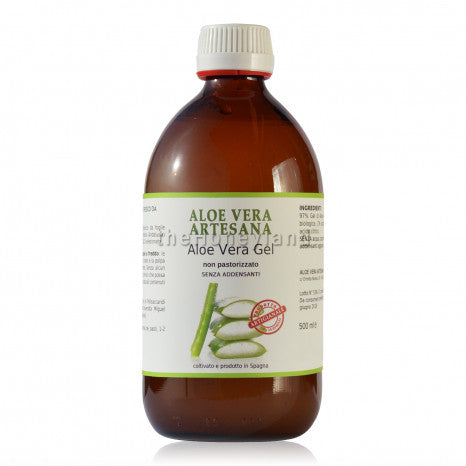
This Aloe Vera gel originates from a certified organic plantation in Andalusia, Spain, where fresh pulp is cold-processed without aloin, thickeners, or any industrial treatment: no pasteurization, no HPP sterilization, and no ionizing radiation. It contains 5,000 mg of polysaccharides per liter—the industry standard for measuring true aloe quality. Supplied in a 500 ml dark glass bottle.
No Thermal Treatment, No HPP — The Glass is Proof
This gel is neither pasteurized nor sterilized via HPP (High-Pressure Processing), nor is it subjected to ionizing radiation. It is important to clarify this distinction: many manufacturers claim "unpasteurized" while referring only to thermal pasteurization, yet they use HPP, which is effectively an industrial sterilization process.
This aloe gel undergoes none of these processes. While this choice results in a shorter shelf life, it ensures that the product reaching your bottle is as close as possible to the freshly harvested plant.
5,000 mg/L of Polysaccharides: Verified by the University of Elche
Polysaccharides, including acemannan, are the most researched molecules in aloe vera and the primary indicator of its quality. Many manufacturers claim "high polysaccharide content" or "rich in acemannan" without providing numerical values or verifiable sources.
The polysaccharide content of this gel—5,000 mg per liter—was measured in a study by the Miguel Hernández University of Elche (Spain) on the fresh product. This value is approximately 3 to 5 times higher than the concentration found in typical commercial aloe vera drinking products.
Certified Organic Plantation in Andalusia — Outdoors, Not Greenhouse-Grown
The aloe vera used for this gel is grown outdoors in the small village of La Rabita, on the Andalusian coast, in an ideal microclimate: warm, breezy summers, mild winters tempered by the sea, and direct sunlight year-round.
The plantation is certified organic (No. ES-ECO-001-AN.724-0023429.2025.001) by the Comité de Agricultura Ecológica de Andalucía.
Aloe barbadensis is a tropical plant that reaches its highest concentration of active compounds when grown outdoors in its natural climatic conditions. In Italy, the winter climate almost always requires greenhouse cultivation, which results in less sunlight exposure and less vigorous plant development—which is why outdoor cultivation is only viable in the southernmost Mediterranean regions.
The difference isn't just geographical; outdoor growing conditions directly impact the concentration of active compounds within the plant.
True Drinking Gel, Not Reconstituted Juice
Most products labeled as "aloe gel" on the market are actually liquid juices—often reconstituted from powder and diluted with water—to which synthetic or natural thickeners (such as carbomer, xanthan, or guar gum) are added to artificially simulate the plant's natural gelatinous density.
This gel is pure raw pulp: the leaves are peeled entirely by hand, leaf by leaf, following the ancient traditional Spanish method. The result is a thick consistency—the same as the fresh plant—with no added thickeners.
Aloin-Free: Only the Purest Heart of the Leaf
This product complies with European food safety regulations for aloe vera gel-based products. While most manufacturers remove aloin through activated carbon filtration or other mechanical processes, we remove it exclusively through manual, total peeling of the leaf.
No Sodium Benzoate, No Added Water
This gel contains no sodium benzoate or other aggressive synthetic preservatives. The only additives on the label are ascorbic acid and citric acid, used as antioxidants and preservatives to maintain product stability. It contains no added water, is not reconstituted from concentrate, and is GMO-free.
Artisanal product, limited quantity
Produced in Spain (Andalusia)